

A water leak doesn’t have to be gushing to be expensive. Some of the costliest leaks in Austin homes are the ones you can’t see — slow seeps under slabs, pinhole drips inside walls, running toilets that lose water silently overnight. By the time the damage becomes obvious, you’ve already been paying for it on your water bill for months. Here’s how to catch them early.
Key Takeaways
- Your water meter can tell you if a leak exists right now — a simple test takes about two minutes and costs nothing.
- Slab leaks are common in Austin due to expansive clay soil that shifts pipes under constant pressure — warm spots on floors are a key warning sign.
- A running toilet can waste 200+ gallons a day — often silently, with no visible overflow.
- Camera inspection technology lets plumbers pinpoint leaks without tearing open walls or floors unnecessarily.
Your Water Bill Is the First Clue
The single most reliable early indicator of a hidden leak is a water bill that’s higher than it should be — especially if your habits haven’t changed. In Austin, average residential water use is a known quantity based on household size and season. If your bill spikes 20–30% without an obvious explanation (filled the pool, watered more during a heat stretch), that’s worth investigating.
The tricky part is that small leaks don’t always show up dramatically on a single bill. A 100-gallon-per-day leak might add only a few dollars to one month’s statement — but over a year, that’s 36,500 gallons and a meaningful dollar amount, plus whatever structural damage the water caused in the meantime.
The Water Meter Test (Do This Now)
This is the fastest way to know whether you have an active leak somewhere in your home’s supply lines. Here’s how:
- Step 1: Turn off every water fixture in and around your home — faucets, hose bibs, ice makers, everything.
- Step 2: Locate your water meter (usually near the street, under a concrete or plastic lid in the ground) and take a photo of the current reading — or just note the exact numbers.
- Step 3: Wait 15–20 minutes without using any water. Then check the meter again.
- Step 4: If the reading has changed at all, water is moving through your supply lines even with everything shut off. That’s a leak.
Many meters also have a small triangle or star-shaped flow indicator that spins when water is moving. If that indicator is spinning with everything turned off, you don’t even need to wait — you have a leak.
Warm Spots on Floors: The Austin Slab Leak Warning
Walk around your home in bare feet sometime — especially on tile or concrete floors. If you notice a warm patch on the floor that doesn’t correspond to a heating vent or direct sunlight, take it seriously. Warm spots on floors are a classic indicator of a hot water line leaking beneath the slab.
Austin’s expansive clay soil is particularly hard on under-slab plumbing. As the soil swells when wet and shrinks during dry spells — and Central Texas has both, often in the same season — the ground exerts constant movement and pressure on pipes and their joints. Over time, that stress causes pinhole leaks and joint failures in copper lines that can be 20, 30, or 40 years old.
Slab leaks are serious, but they’re not automatically catastrophic — if you catch them early. Left unaddressed, the water erodes soil beneath your foundation, which can cause settling and structural problems that are dramatically more expensive to fix than the plumbing itself. If you spot a warm area on your floor, unusual dampness in a spot that doesn’t get wet otherwise, or hear water running when nothing is on, call a plumber. Our water line services team handles slab leak detection and repair throughout the Austin metro.
Mold, Musty Smells, and Discolored Walls
Mold needs three things to grow: a food source (drywall, wood framing), warmth, and moisture. Austin’s humidity already provides the warmth and some ambient moisture — a hidden leak gives mold everything else it needs. If you notice a musty odor in a bathroom, under a cabinet, or in a section of wall that shouldn’t be damp, trust your nose. Mold behind walls often produces that characteristic smell before it’s visible from the outside.
Staining or soft spots on drywall, paint that’s bubbling or peeling without obvious cause, or baseboards that are swelling at the bottom are all signs that water has been sitting in a wall cavity. These are worth a plumber’s assessment before you assume it’s a cosmetic issue.
Wizard Pro Tip: Check under every sink in your home — kitchen, bathrooms, laundry — at least twice a year. P-traps, supply lines, and drain connections are the most common locations for slow drips that go unnoticed because nobody looks under there. A little moisture on the cabinet floor is easy to miss until there’s mold growing on the shelf liner.
The Silent Toilet: A Surprisingly Expensive Leak
A running toilet is one of the most common and most underestimated water wasters in any home. The culprit is almost always a worn flapper valve — the rubber seal at the bottom of the tank that closes after a flush. When it doesn’t seal completely, water trickles continuously from the tank into the bowl and down the drain. You may not hear it at all, especially in a bathroom with the door closed.
A leaking toilet can waste anywhere from 30 to 200+ gallons per day depending on how badly the flapper is worn. A quick test: put a few drops of food coloring in the tank and don’t flush for 15 minutes. If color appears in the bowl without flushing, the flapper isn’t sealing. A flapper replacement is a simple fix — but you have to know to look for it. Our plumbing repairs team handles these on service calls throughout the Austin area, and if you’ve got multiple toilets, it’s worth checking them all at once.
How Camera Inspection Technology Changes the Game
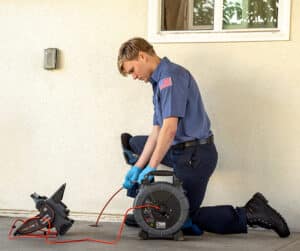
Not long ago, finding a hidden leak meant a plumber’s best educated guess followed by opening walls or floors to investigate. Today, video camera inspection lets us run a flexible camera through your drain and sewer lines to see exactly what’s happening inside — scale buildup, root intrusion, cracks, joint failures, bellied sections — without tearing anything apart unnecessarily.
That information matters enormously. It’s the difference between a targeted repair and exploratory demo that damages finished surfaces. It also gives you documentation of your pipe condition — useful if you’re buying or selling a home, or just want to know what you’re working with in an older Austin house.
Right now, Service Wizard is offering $90 drain clearing with a free camera inspection — so you get a clear look at what’s inside your lines at the same time. See our current specials page for full details and any other active offers.
When to Call a Plumber (Not “Eventually” — Now)
Some plumbing issues are fine to monitor. A hidden leak is not one of them. If your water meter test showed movement, if you’ve got a warm spot on the floor, if the musty smell won’t go away, or if your bill has been creeping up without explanation — the right move is a professional assessment now, not after the next billing cycle.
The cost of detection is almost always a small fraction of the cost of the damage a long-running leak causes. Water doesn’t wait, and Austin clay soil doesn’t give your foundation much margin for error.
Service Wizard’s licensed plumbers (M-39879) are available 7 days a week across the greater Austin metro — from Georgetown and Cedar Park to Kyle, Pflugerville, and everywhere in between. Check our service areas to confirm we cover your city, then give us a call. Our drain and sewer services team can investigate, diagnose, and walk you through your options with upfront pricing before any work begins — that’s our standard, not an upsell.
Think You Might Have a Hidden Leak?
Don’t wait for a water bill surprise or foundation damage. Call (512) 873-7333 for same-day service — or book online and we’ll get a licensed plumber out to assess your home fast.





 Your Privacy Choices